


What are the penalties for demolishing a partition wall?
Demolishing a partition wall can completely transform an apartment – opening up the kitchen to the living room, adding more light, or improving the functionality of the rooms. However, before you begin renovations, it's worth checking one thing: is the wall really just a partition? This will determine whether the work will be considered a simple interior design project or one that might involve formalities, responsibilities, and additional costs.
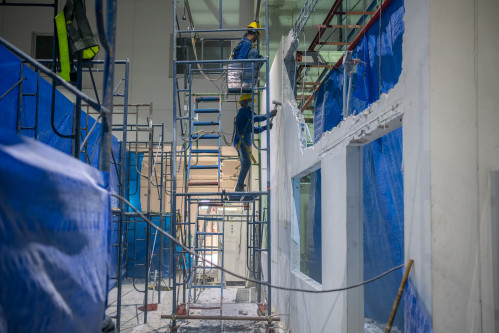
Penalty for demolishing a partition wall
A fine for demolishing a partition wall does not automatically apply for every interior wall removed. The General Office of Building Control (GUNB) clearly states that such work is related to ongoing interior design , not construction work covered by administrative procedures.
Risks arise when the wall is not a standard partition wall, or when the work disrupts elements crucial to the entire building. The consequences are determined by the actual scope of the work and its technical impact on the building , not by its designation.
Key conditions for no penalty:
- the work is carried out only within the premises of the resident,
- the wall is completely non-structural (it is neither load-bearing nor stiffening),
- dismantling does not affect the building structure, common parts or technical parameters of the facility,
- the robots do not interfere with neighboring premises or common installations.
Risks and penalties occur when:
- the wall proves to be load-bearing or stiffening, and its removal threatens the statics of the building,
- the demolition will damage the ceiling, chimney, ventilation shaft or common installations,
- the works will cause damage to the neighbor (e.g. cracks in the plaster in the apartment next door),
- you damage the staircase, elevator or other common part of the building,
- you will perform works classified as reconstruction without the required formalities.
Financial and administrative consequences
Financial consequences arise primarily when renovations violate regulations, building safety, or the rights of others. The fine itself is often not the biggest problem. Repairs after a poorly executed demolition and the costs of restoring the original condition can be much more expensive .
Construction law does not provide for a single, automatic penalty for unauthorized construction of partition walls. However, if the work damages the structure and is deemed unauthorized reconstruction, a strict statutory tariff system and the Code of Procedure for Misdemeanor Cases come into play.
The most important consequences are:
- Fine up to PLN 500
- (or up to PLN 1,000 in the case of multiple offenses) pursuant to Article 93 of the Construction Law.
- Suspension of further work
- construction by the District Building Supervision Inspector (PINB).
- High legalization fees
- (from several to several thousand zlotys) if the load-bearing wall was arbitrarily rebuilt.
- Order to perform a technical expertise
- and the constructor's opinion at the sole expense of the owner of the premises.
- Administrative order to rebuild the wall
- or the implementation of expensive reinforcements (e.g. steel beams).
- Compensation claims
- from neighbors, housing communities or cooperatives.
The legal basis for the penalty in the provisions of construction law
The legal basis for this assessment is the Building Law. The current interpretation by the General Inspectorate of Building Supervision (GUNB) indicates that the provisions of the Act apply to work in residential premises only if they affect the parameters or structure of the building as a whole .
Work on non-structural partition walls does not constitute reconstruction within the meaning of Article 3, Section 7a of the Building Law and is not subject to notification to the authorities. The situation is different if you disturb load-bearing elements – in which case you will need a design and a formal permit or notification .
In practice, you have to distinguish between two legal areas:
- obligations towards the office (Construction Law)
- – required only when interfering with the supporting structure, ceilings or technical parameters of the building,
- obligations towards the manager (Civil law/regulations)
- – include compliance with renovation regulations, protection of common property and principles of social coexistence.
The lack of an obligation to report to the office does not mean complete arbitrariness. You are still civilly liable for any property damage and personal safety.
Formalities before demolishing a partition wall
Don't assume a wall is a partition just because it's thin. In older buildings or prefabricated systems, even thin walls (10-12 cm) can serve important structural stiffening functions .
Before starting work, you must make sure that there are no hidden installations in the wall or directly next to it – electrical, water, gas or ventilation pipes.
Necessary formal and technical steps:
- Documentation analysis – download the floor plan of the premises or the construction design from the cooperative, community or developer,
- installation location – check the route of wall cables to avoid electric shock or flooding,
- notifying the manager – inform the administration about the deadline for the work, this is often required by internal regulations,
- logistics organization – establish rules for using the elevator, secure the stairwell and order a legal container for rubble.
When is a simple renovation plan enough?
A simple renovation plan is sufficient if you're completely removing a non-structural partition wall and not interfering with common areas or central utilities. In this case, the building inspection office won't require any notification, and you won't face a fine for demolishing a partition wall.
Your only responsibilities are then:
- ensuring the safety and hygiene of work on the premises,
- maintaining cleanliness in the stairwell and elevator,
- observing the silence hours set by the building regulations,
- legal disposal of renovation waste (no throwing debris into municipal bins).
When is a designer's opinion needed?
The opinion of a licensed engineer is absolutely required when:
- you do not have the original technical documentation of the building,
- you live in an older prefab building or a tenement house with wooden ceilings,
- cracks and scratches are visible on the ceiling line or on the wall itself,
- the wall has an unusual thickness or an unusual connection with the ceiling.
Supporting structure and wall demolition
The biggest mistake is to confuse a partition wall with a load-bearing wall, which is responsible for the statics and safety of the entire building , transferring loads from the ceilings, roof and upper floors.
What can a designer do during an expertise:
- will analyze the archival construction designs of the building,
- determine the direction of the ceiling span and the course of vertical loads,
- examine the technical condition and possible stresses in the area of planned works,
- will make a clear decision as to whether the wall can be safely removed.
Demolition techniques and construction materials
The removal method depends on the material (plasterboard, brick, aerated concrete, silicate). For brick walls, it's crucial to limit vibrations and heavy dusting , which can damage adjacent plaster or installations.
Rules for proper wall demolition:
- Always carry out demolition from top to bottom, in small and controlled sections,
- never cut the wall at the bottom to avoid it collapsing uncontrollably onto the ceiling,
- use tools with low impact energy (e.g. diamond saws instead of heavy demolition hammers),
- pack and remove rubble on an ongoing basis – heaps of waste can overload the ceiling of the premises in certain places.
Safety and health and safety during wall demolition
During demolition, the greatest hazards are silica dust, high noise levels, risk of electric shock and sudden damage to water or gas installations.
Health and safety rules before the first impact:
- locate and disconnect the electrical power supply in the demolition zone,
- close the local water and gas shut-off valves,
- use personal protective equipment for all employees,
- Spray the structure with water to minimize dust spreading through ventilation to neighbors.
Post-demolition process and supervision
After completing the work, you must protect your interests in the event of any claims from neighbors or the administration.
List of post-completion activities:
- take detailed photos of the final effect (where the walls and ceiling meet),
- keep invoices, the contract with the contractor and confirmation of legal disposal of debris,
- attach the constructor's opinion to the property ownership documents,
- Inspect ceilings and floors for possible micro-cracks.
What to do if the wall has already been demolished without inspection?
The worst solution is to conceal the problem and further mask the renovation area. If you're afraid of fines for demolishing a partition wall, ensure:
- immediate cessation of any further finishing work in this zone,
- taking detailed photos of the exposed areas of the demolished wall,
- calling an authorized constructor for an urgent on-site inspection,
- if the engineer states that the wall was a partition – attach his opinion to the file,
- if the wall was load-bearing – perform immediate shoring (support) and start the repair and legalization procedure before the PINB.
Summary
Demolishing a non-structural partition wall inside a property doesn't require any formalities with the authorities or obtaining permits. However, remember that the absence of official barriers doesn't absolve you of responsibility for the safety of the structure and the peace of your fellow residents.
Always rely on facts and documents, not the renovation team's intuition. A brief consultation with the builder, official notification to the authorities, and legally arranging debris removal are the three pillars that will guarantee you a beautiful interior and complete legal peace of mind.
FAQ – what is worth knowing about demolishing a partition wall?
No, if it's a real partition wall. Interior work that doesn't affect the building's structure or technical parameters doesn't require a notification or building permit under state law. However, check the housing cooperative's regulations, which may require an internal notification for renovations.
When you damage structural or common elements, you may be fined if the wall was actually load-bearing, if you damaged ventilation shafts, gas/water systems, or caused damage to a neighbor. Consequences include a fine (up to PLN 500/1000), a request for a costly expert's assessment, and, in extreme cases, an order to rebuild the wall at your own expense.
Only based on technical documentation or expert assessment. Obtain building plans from the property manager. Wall thickness alone or the sound of knocking do not provide a guarantee. In the absence of documentation, order a technical opinion from a licensed constructor.
No, as long as the work doesn't interfere with common areas. The community or housing cooperative cannot prohibit interior design within your property. However, they do have the right to require compliance with house rules, cleaning of the stairwell, and a constructor's report confirming the wall's condition.
Stop the renovation and call the builder. Take photos of the current technical condition and have an engineer assess the structural integrity of the ceiling. If the wall was a partition, the resulting technical report will settle the matter and protect you from potential complaints from neighbors.